
Renewal through the ages
I visit a Goodwill store and get a nice surprise

An old place gets a new face
One morning in late February I arrived at the Goodwill store at Iliff and Chambers and was astounded to find the parking lot jammed with cars. What until recently had been a sleepy patch of cracked asphalt and scattered leaves now looked like an overflow lot for a convention or rock concert.
Other than the store and a nearby dental clinic—my original destination—empty storefronts had faced the lot. It had onced been a thriving business area; there had been a beauty salon, Sam’s meat market, the local Democratic Party headquarters, and a big church. All had moved away in the past decade. Even the Walgreens corner drugstore was vacant.
But now, those empty buildings were transformed into busy service centers, mostly projects sponsored by Goodwill of Colorado. There is a food pantry, and and a mental health clinic is in the planning stage.
A new school, a new perspective
Most visible in the lot is the Excel Center. According to the Goodwill website, it opened in 2024 as part of a national network of free high schools for adults. The local center is cosponsored by Goodwill and the Colorado Dept. of Education. As one student waiting to enter explained, it is not a GED preparation: “We get a diploma.” Tuition is free, as are other services such as child care, transportation assistance, and career counseling. “I can tell you it’s an amazing program,” said another student.
Applicants must be at least 22 years old, and many are able to transfer previous high school credits. An accelerated program allows them to cover the equivalent of four years of study in one year or less, depending on previous credits. A student who had dropped out of high school “a long time ago”, noted the subject matter, along with his life, has changed a lot since then. “It’s given me a different perspective on learning,” he said.
Rapid results
According to Director David Bechtold, the secret to the rapid rate of learning is a year-round curriculum. There are five terms of eight weeks, and students cover the same subjects they would have taken in high school, minus any credits they have transferred. “Some only take a few terms to finish up,” he said. “Others it may take longer than a year if they cannot attend full time.”
These adult students, he noted, come from many different—and difficult—backgrounds, and appreciate the individual attention assigned counselors provide. “Many students do not have much of a support system,” he explained. “Some students come to us from addiction recovery and incarceration, while others are dealing with mental health issues.”
Statewide, Goodwill programs include staffing for local businesses; helping farmers and ranchers with disabilities (cosponsored by the U.S. Dept. of Agriculture); training for professional certifications including several IT specialties; life coaching and job training for people with disadvantages such as disabilities or prison records; day care; and other community programs. In 2024, Goodwill employeed 3,300 Coloradans in its various programs.
The power of good
A little more research reveals that Goodwill was founded in 1902 in Boston by Edgar J. Helms, a Methodist minister, who devised a charity in which he collected used household goods and clothing in wealthier areas of the city, then trained and hired poor residents to mend and repair the used goods for sale or donation. It is now a $5 billion nonprofit organization, based in Rockville, Maryland, with operations in the U.S. and a half dozen other countries.
That history is worth pondering. Think of it: When the Goodwill brand was founded, this country had yet to suffer through two world wars, and a series of conflicts in Asia and elsewhere. Few people, certainly few in power, bothered to notice that women couldn’t vote, and Black and Native rights were only a dream. The country surely needed some good will, and it was in short supply.
And today…that’s still true. How appropriate that in Aurora and elsewhere across the country and the world, people are still saying, and benefiting from, the name of Goodwill. <>
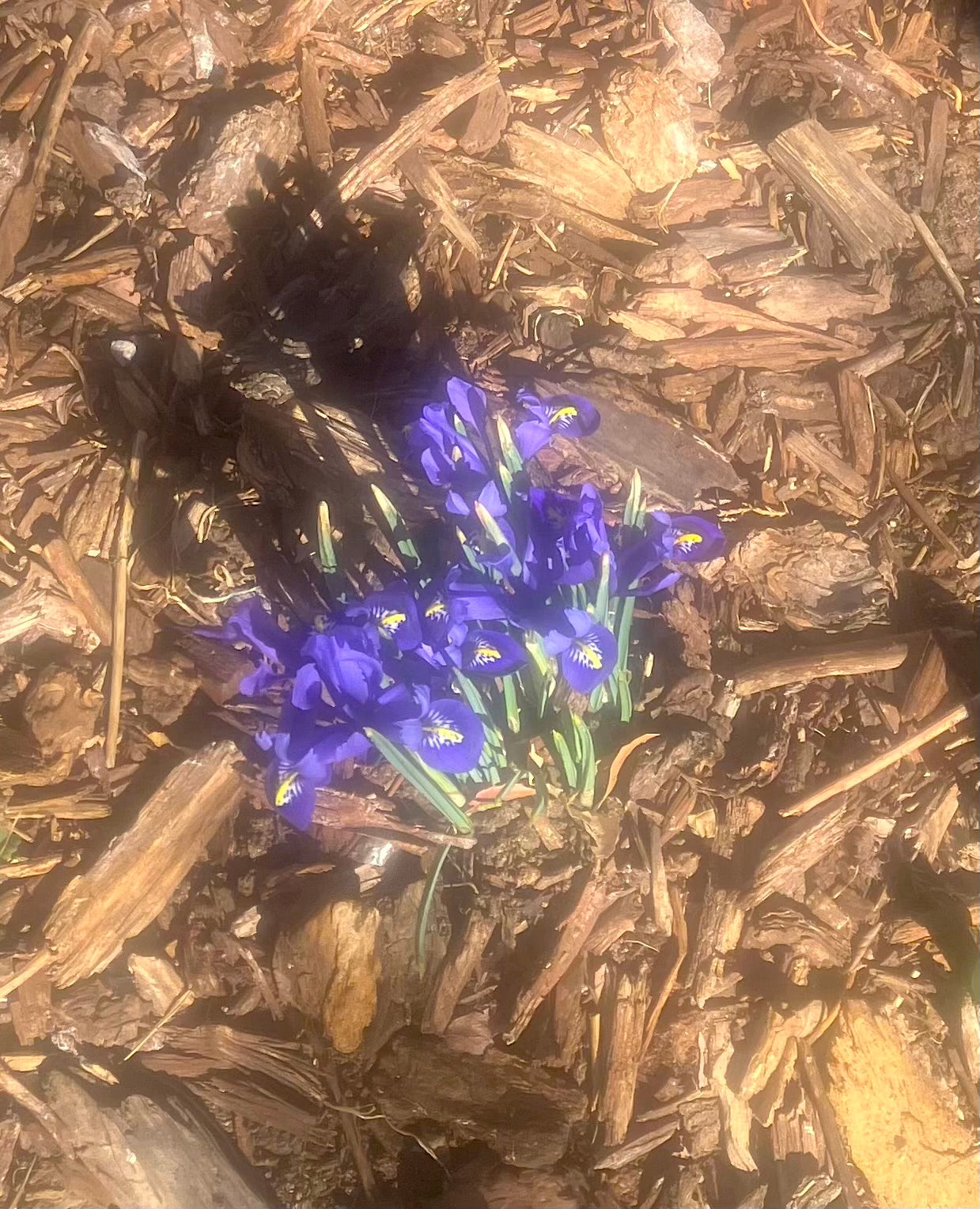
My garden in February
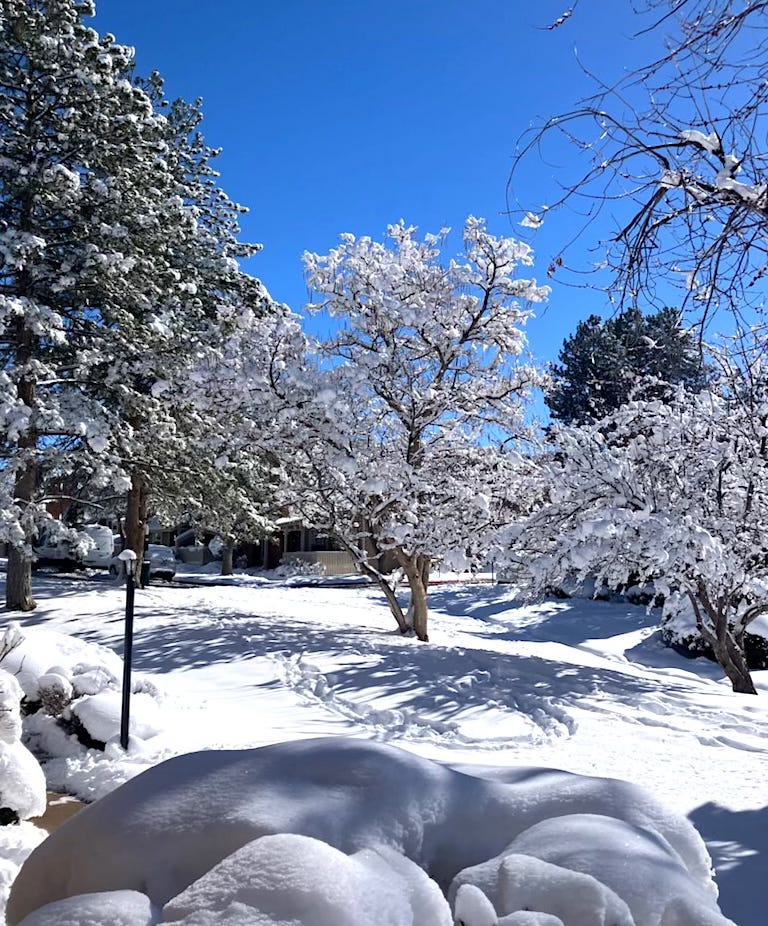
My yard in March
Our founding father was a real estate developer
In the last issue, we learned of the city’s prehistoric past from the Aurora History Museum. The city’s website and the Colorado Encyclopedia provide more information about the human era.
In the early 19th century, two major tribes joined forces on the wide plains: the Arapaho and Cheyenne. They hunted bison together and fought enemies such as the Crow, Kiowa and Comanche.
At some point, they must have encountered the segment of white travelers who decided to settle in the area. In any case, the town of Fletcher was incorporated on April 30, 1891, and was named after Donald Fletcher, a local real estate developer. According to city records, the original town covered four square miles and had 39 residents. The name was changed to Aurora in 1907. Its population is now about 414,000, and the city covers 165,000 square miles in three counties.
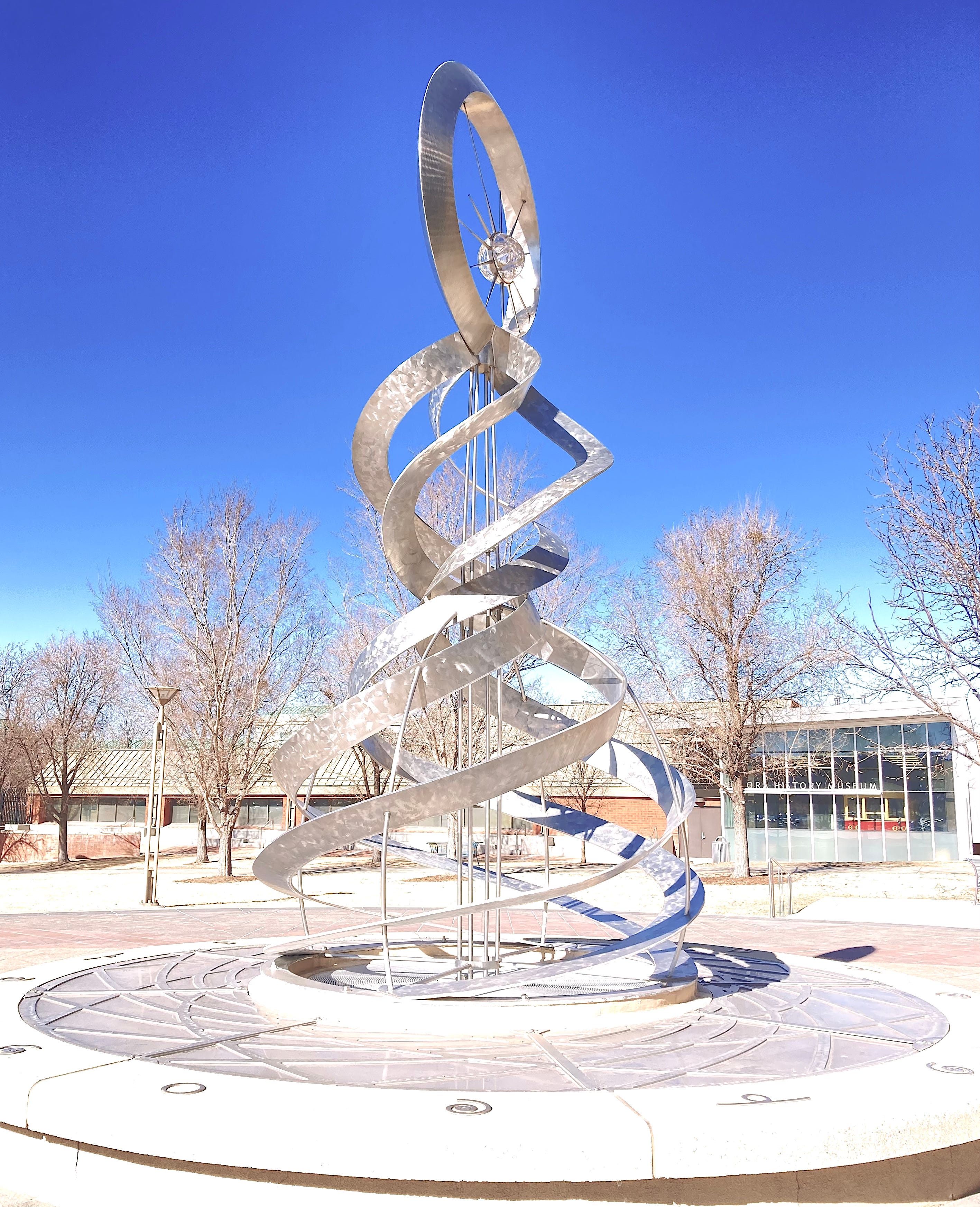
The Light of Dawn, a sculpture in front of the Aurora Municipal Building, by Rafe Ropek
Why the new name?
When I decided to quit the position of editor of High Altitude Hearing, I thought I would leave the subject of hearing loss behind. Of course, I still have hearing loss, as do many of you. So it will be hard to stay completely off that topic.
Meanwhile, we are taking a look at the many ways we are all connected, through the experiences of people we meet every day. I love travel, but for now I’m looking at the world from Aurora, Colorado, my home for 30 years. And, I’m finding that right here in town (or nearby) are reflections of life around the world: people, food, culture, and beliefs. Let me know in the comments what you think and what else you’d like to see.—Paula